Futurion
 · Maria Kovaleva · Articles · 2 min read
Neurorehabilitation Master students from Universidad Loyola immerse themselves in technology and clinical practice in Valencia
Students from the Neurorehabilitation Master at Universidad Loyola visit three centres of excellence in Valencia: IRENEA, the NRHB research group at UPV, and the Institute of Biomechanics, combining virtual reality, motion capture and real clinical practice.
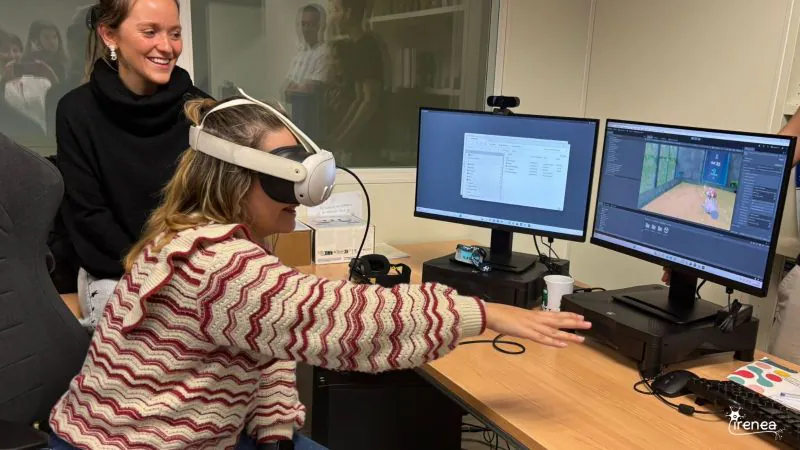
Students from the Master’s Degree in Neurorehabilitation at Universidad Loyola are undertaking a training visit in Valencia to gain first-hand experience of the work carried out by leading centres and research groups in neurorehabilitation and biomechanics. This activity forms part of the practical, multidisciplinary approach of the Master’s programme, which combines theory, advanced technology, and real clinical integration.
Over two days of intensive immersion, the students visited:
- IRENEA — Instituto de Rehabilitación Neurológica, a reference centre for the care and treatment of people with acquired brain injury and other neurological conditions.
- Neurorehabilitation and Brain Research Group (NRHB) at the Universitat Politècnica de València (UPV), where they explored research projects integrating neuroscience, virtual reality, brain stimulation, and advanced techniques to promote functional recovery after brain injury.
- Instituto de Biomecánica (IBV) — a technology centre with decades of experience in human movement analysis, ergonomics, and technologies applied to clinical assessment.
From theory to practice
Accompanied by faculty from the Master’s programme — including Loles Navarro, the programme director, and other professionals from IRENEA — the students toured laboratories equipped with motion capture technology, tried virtual reality systems for sensorimotor stimulation, and observed technological platforms used in research and clinical practice. This experience enabled them to understand how assistive tools are developed and subsequently applied with real patients.
An innovative educational approach
This type of activity is embedded in the educational philosophy of the Master’s programme, which seeks to involve students in real-world experiences that strengthen their professional competencies:
- 100% practical training, with over 250 hours in real environments and reference centres.
- Based on complex clinical cases and the integration of scientific knowledge with clinical care.
- Oriented towards the use of robotics and new technologies to address the needs of neurological patients.
- Interdisciplinary approach and clinical reasoning, essential for professionals in physiotherapy, occupational therapy, medicine, and speech and language therapy.
Through this approach, students not only gain an understanding of the theoretical foundations of neurorehabilitation, but also develop the skills to integrate innovative technologies into everyday clinical practice.
Valencia is a leader in healthcare innovation and quality of life. If you want to enjoy everything it has to offer, find out how we can help with Retirement in Spain or the Longevity Experience.