Futurion
· Maria Kovaleva · Articles · 4 min read
Epigenetic reprogramming: can we turn back the age of cells?
The idea sounds like science fiction: not just slowing down aging, but partially returning a cell to a younger state.
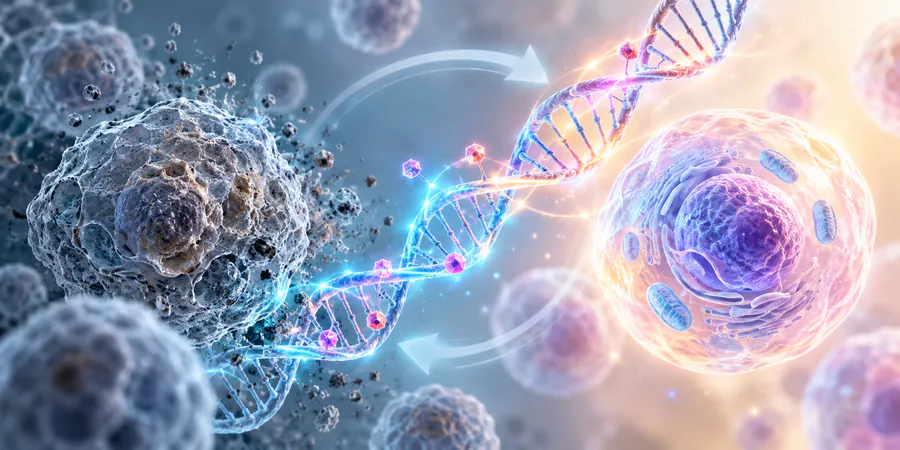
The idea sounds like science fiction: not just slowing down aging, but partially returning a cell to a younger state.
This is precisely what one of the most interesting areas of the biology of aging studies: epigenetic reprogramming.
It is worth making one thing clear from the start: today there is no rejuvenation therapy of this kind approved for people. Most of the solid results come from studies in cells and animals. Even so, it has already been shown experimentally that some features associated with cellular aging can be modified.
What is epigenetics?
Almost all the cells in our body contain the same DNA, but they do not function in the same way. A neuron, a skin cell and a liver cell use different parts of that genetic information.
Epigenetics is, in simplified terms, the system that helps the cell decide which genes to activate and which to keep switched off.
With age, this system changes. DNA methylation, chromatin organization and the activity of certain genes are altered.
This raises a very important question:
if some of the changes associated with aging are related to the regulation of genes, can we modify some of them in the opposite direction?
Where the idea of reprogramming a cell comes from
A fundamental discovery was the so-called Yamanaka factors: OCT4, SOX2, KLF4 and c-MYC.
When used in full, they can make an adult cell return to a state similar to that of a stem cell.
The problem is that this process is too radical to speak simply of rejuvenation: the cell may lose its identity and stop behaving like a skin, muscle or retinal cell.
That is why researchers study partial reprogramming.
The idea is to apply these signals in a limited and controlled way to modify some age-related features without erasing the identity of the cell.
What has been achieved so far?
One of the best-known studies was published in Nature in 2020.
The researchers used three factors —OCT4, SOX2 and KLF4— in mouse retinal cells. They observed epigenetic changes associated with a younger state, greater regeneration of nerve fibers and a partial recovery of visual function in aged animals and in glaucoma models.
Subsequently, similar approaches have been studied in other tissues.
This does not mean that the animals fully “rejuvenated.” But it does show something very relevant:
some age-related cellular characteristics may be more reversible than was thought.
Does this mean a cell really becomes young again?
It is still too early to say so.
Researchers can measure changes in:
- DNA methylation;
- the activity of certain genes;
- regenerative capacity;
- some tissue functions.
But improving these parameters does not necessarily mean that the whole cell, tissue or organism has rejuvenated.
One of the major scientific challenges is to distinguish true rejuvenation from a situation in which the cell simply begins to lose its specialization.
The main problem: safety
Cellular reprogramming is an extremely powerful process.
The more a cell is pushed toward a primitive state, the greater the risk of losing control over its behavior.
Reprogramming factors are related to mechanisms of cell division and pluripotency. If the process is too intense or prolonged, the cell may lose its identity and the risk of abnormal growth may increase.
In experimental models, uncontrolled reprogramming can even produce teratomas, a type of tumor made up of different types of tissue.
That is why the real scientific goal is not simply to “make a cell younger,” but to achieve it in a precise, localized and safe way.
Aging does not have a single switch
Another important point is that aging does not depend on epigenetics alone.
Other processes are also involved:
- DNA damage;
- chronic inflammation;
- mitochondrial alterations;
- cellular senescence;
- changes in the immune system;
- loss of regenerative capacity.
Therefore, even if we managed to modify some epigenetic signs of aging, that would not automatically mean correcting all the other processes associated with age.
Can this type of treatment already be received?
No.
Partial epigenetic reprogramming is not currently a standard anti-aging therapy for human beings.
There is still not enough data to consider it a safe and effective form of human rejuvenation.
Current studies continue to indicate that we do not yet have interventions capable of convincingly demonstrating that they slow the fundamental processes of aging in people.
So why is it so important?
Because it is changing a basic idea in biology.
For a long time it was assumed that many age-related cellular changes were practically irreversible.
It is now beginning to become clear that some of them may be more plastic and modifiable than was believed.
This could have important implications for regenerative medicine and, in the future, for the treatment of age-related diseases.
Today, epigenetic reprogramming is not a rejuvenation therapy, but one of the most promising lines of modern research on aging.